






Global e-commerce reached $6.3 trillion — in this fierce competition, data is the decisive advantage. This guide covers using proxies for e-commerce: price monitoring, data scraping, seller account management, and the best proxy solution from TMProxy.
E-Commerce and Proxy: The Secret Weapon of Professional Sellers
Global e-commerce reached $6.3 trillion in 2025. In this fierce competition, information is power — whoever captures data fastest wins.
But e-commerce platforms (Amazon, Shopee, Lazada, eBay) all have powerful anti-bot systems. Too many requests from 1 IP → instant block. Prices displayed vary by region. Search results are personalized.
Proxies solve everything:
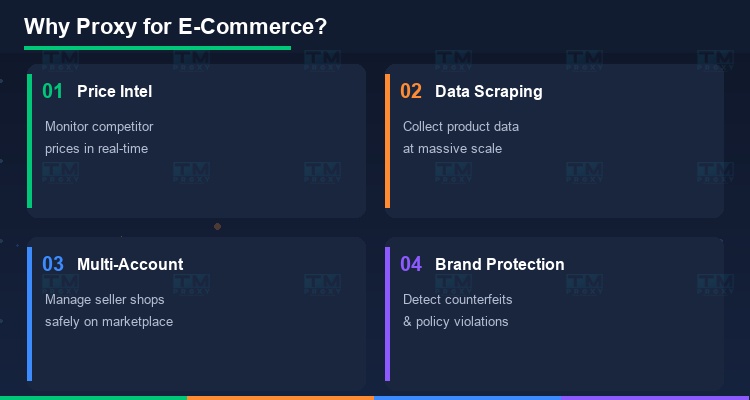
- Monitor competitor pricing in real-time, from any country
- Cross-border price comparison — same product, different prices in US, EU, SEA
- Scrape product data at scale without getting blocked
- Brand protection — detect counterfeits, policy-violating sellers
- Manage multiple seller accounts safely on the same marketplace
The best proxy for E-commerce
TMProxy — residential & rotating proxy for price monitoring, from $0.5/GB
Use Case #1: Price Intelligence
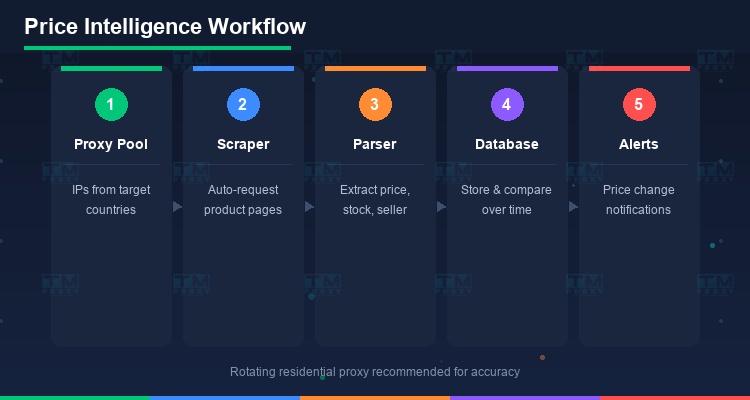
This is the most popular proxy use case in e-commerce:
Why do you need proxies for price monitoring?
Marketplaces display different prices based on:
- IP location — prices in the US differ from prices in Vietnam for the same product
- Browsing history — cookies and fingerprints affect dynamic pricing
- Timing — prices change hourly based on demand
Without proxies, you only see prices from 1 perspective. With a large proxy pool, you see real prices from every angle.
Practical workflow:
- Set up a proxy pool with IPs from target countries (US, EU, Japan, SEA)
- Scraper automatically requests product pages via rotating proxy
- Parse price, stock status, seller info
- Store in database, compare over time
- Alert when competitors change prices or go out of stock
Popular tools: Scrapy + rotating proxy, Puppeteer, Playwright, or SaaS solutions like Prisync, Competera.
Use Case #2: Product Data Scraping
Large-scale product data collection is the foundation of every e-commerce strategy:
Data to collect:
- Product name, description, images, specifications
- Price, price history, promotions
- Reviews, ratings, units sold
- Seller info, shop rating
- Warehouse location, delivery time
Challenges when scraping marketplaces:
Amazon has the most sophisticated anti-bot system. Rate limiting, CAPTCHA, IP blocking happen constantly. Shopee and Lazada use complex JavaScript rendering. eBay tracks request patterns.
Solutions:
- Rotating residential proxy — change IP per request or every few minutes
- Fingerprint randomization — combine with headless browser
- Request throttling — space requests 2-5 seconds apart, random delay
- Session management — sticky sessions for workflows requiring login
Use Case #3: Multi-Seller Account Management
Many sellers run multiple shops on the same marketplace to diversify risk:
Basic rules:
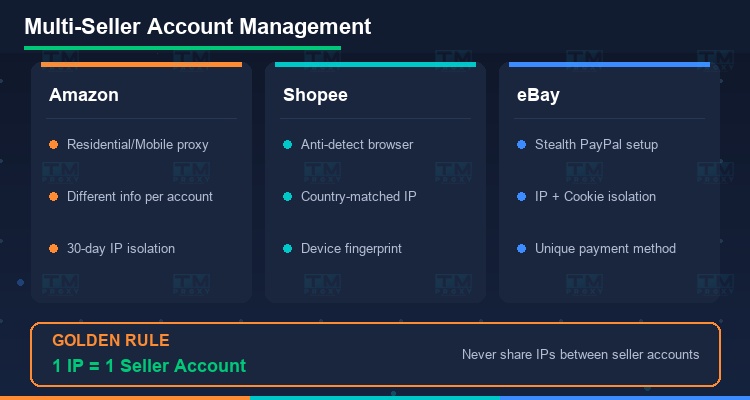
- 1 IP = 1 seller account. Never share
- Use anti-detect browser (GoLogin, Multilogin) for each account
- Proxy IP must match the shop's registration country
- Sticky sessions — keep a fixed IP for each shop for at least 24h
Platform-specific tips:
Amazon: Extremely strict. Use residential or mobile proxy. Don't log into 2 seller accounts from the same IP within 30 days. Each account needs completely different info (email, phone, card, address).
Shopee: Strong device fingerprint tracking. Anti-detect browser is mandatory. VN proxy for VN shops, MY proxy for Malaysia shops.
eBay: Links accounts via IP + cookies + PayPal. Proxy needs to be combined with stealth PayPal setup.
Use Case #4: Brand Protection
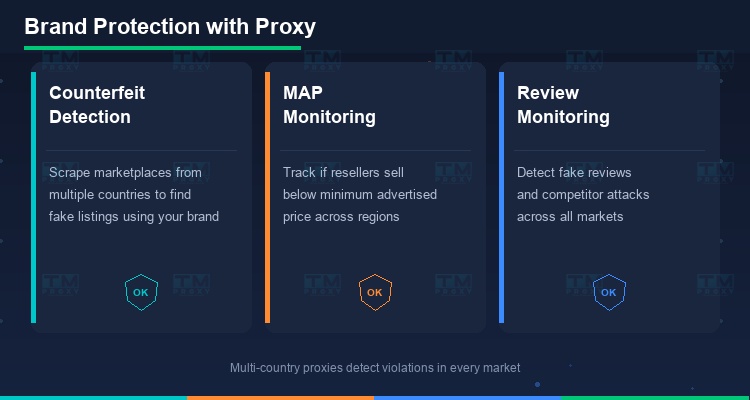
Proxies help brand owners detect and handle violations:
Counterfeit detection: Scrape marketplaces from multiple countries to find listings selling counterfeits using your brand. Multi-country proxies help detect violations in every market.
MAP monitoring (Minimum Advertised Price): Track whether resellers are selling below the price floor. Proxies help check displayed prices in multiple regions — some resellers only violate in specific markets.
Review monitoring: Detect fake reviews, intentional negative reviews from competitors. Proxies help view reviews from a customer's perspective in multiple countries.
TMProxy for E-Commerce
TMProxy is designed for e-commerce professionals:
- Residential Proxy in 100+ countries — global price monitoring
- Rotating Proxy — automatic IP rotation per request, optimized for scraping
- Sticky Sessions — fixed IP for seller account management
- High concurrency — thousands of simultaneous requests for price monitoring
- API integration — easy integration with Scrapy, Puppeteer, custom tools
| Metric | Free Proxy | Datacenter | ALGO Residential |
|---|---|---|---|
| Scrape success (Amazon) | 8% | 35% | 96.8% |
| Scrape success (Shopee) | 12% | 48% | 98.2% |
| Avg response time | 8.5s | 2.1s | 1.2s |
| IPs blocked after 1000 req | 95% | 60% | 3% |
| Price/GB | $0 | $0.3 | $0.5 |
Result: TMProxy achieves >96% success rate on Amazon and Shopee, far outperforming datacenter proxies in stability and speed.
Get started at https://vn.tmproxy.com/ — comprehensive proxy solution for e-commerce.
Conclusion: In e-commerce, data is your biggest competitive advantage. Proxies give you the ability to collect data at a scale your competitors can't match, monitor prices in real-time, and manage multiple shops safely. Investing in quality proxies is investing in the future of your e-commerce business.