





You spend on advertising, launch products and run campaigns — but is your brand getting stronger or weaker? If you cannot answer with numbers, you are driving without a dashboard. Brand measurement is that dashboard.
What is brand measurement and why B2B companies need it now
High-Speed Proxy - Ready to Try?
ALGO Proxy offers residential, datacenter & 4G proxies in 195+ countries
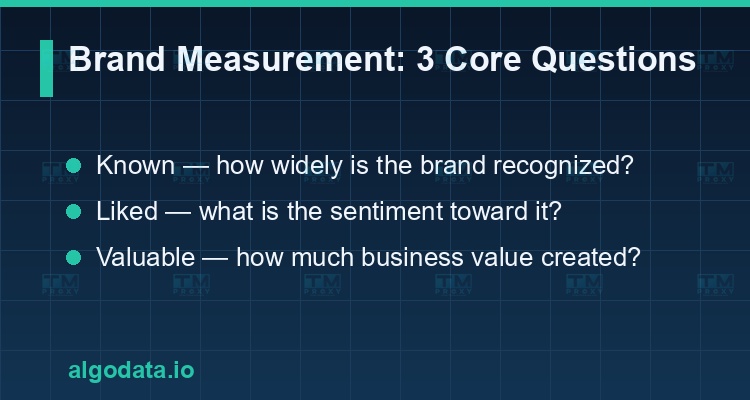
Brand measurement is the quantification of a brand's value and effectiveness through concrete metrics, rather than subjective perception. It answers three core questions: how widely your brand is known, how well it is liked, and how much real business value it creates.
For B2B companies, brand measurement matters even more because buying cycles are long and purchase decisions rely heavily on reputation. A strong B2B brand helps you:
- Shorten the sales cycle — prospects already trust you before sales reaches out
- Command higher prices — a trusted brand does not compete on price alone
- Lower customer acquisition cost — inbound leads arrive naturally thanks to strong recognition
The problem is that most companies still measure brand by gut feeling, or survey only once a year — far too slow for timely decisions.
Brand health — the foundational concept
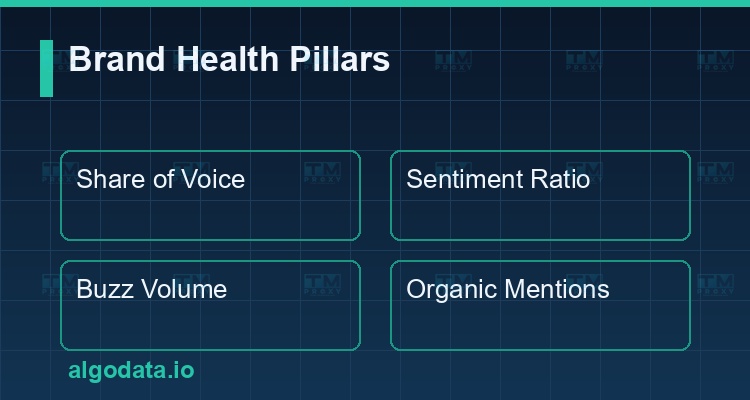
Brand health tracking monitors the current state of your brand in the market, in near real time. It is a "regular check-up" for your brand and includes:
- Share of Voice (SoV) — your share of discussion relative to the whole industry. If a competitor owns 60% of social mentions and you own 5%, that is a warning sign.
- Sentiment — the ratio of positive / neutral / negative tone in mentions of your brand.
- Buzz Volume — total mentions, showing whether the brand is being talked about or falling into silence.
- Organic brand mentions — how often your brand is mentioned without paid advertising.
How is brand equity measured?
Brand equity targets long-term accumulated value — the thing that makes customers choose you even when competitors are cheaper. It is built from:
- Brand Loyalty — repeat-purchase rate, net promoter score (NPS)
- Brand Associations — what customers think of when they hear your name
- Perceived Quality — how customers rate your quality versus competitors
- Price Premium — how much above market you can charge while keeping customers
Brand equity measurement usually combines periodic surveys (depth) with continuous social data (freshness) for a complete picture.
Brand awareness — methods of measurement
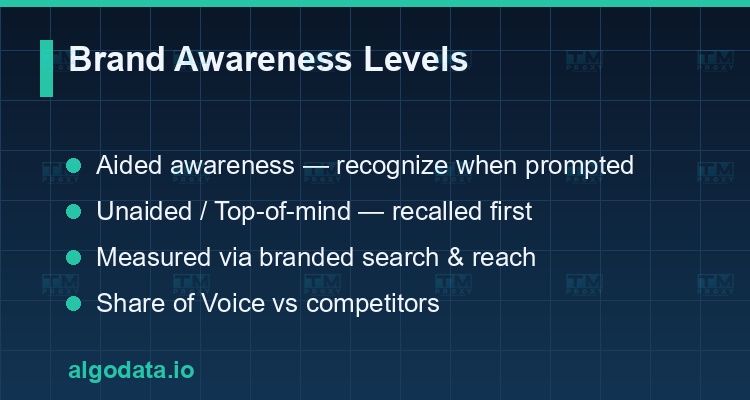
Brand awareness tells you how many people in your target market know you. There are two levels:
- Aided awareness — when prompted with the name, does the customer recognize the brand?
- Unaided / top-of-mind awareness — does the customer recall your brand first when thinking about the category? This is the most valuable level.
How to measure awareness in the digital space:
- Branded search volume (people actively searching your name = strong awareness)
- Organic reach and impressions on social media
- Share of Voice versus competitors on the same topic
- Mention rate in industry discussions you did not initiate
The 10 most important brand metrics
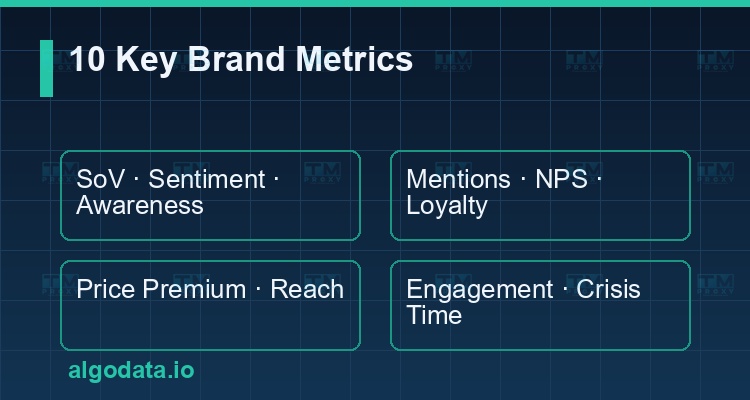
| # | Metric | What it measures | Data source |
|---|---|---|---|
| 1 | Share of Voice | Discussion share vs competitors | Social listening |
| 2 | Sentiment Score | Positive/negative tone ratio | Social listening |
| 3 | Brand Awareness | How widely known | Survey + search volume |
| 4 | Brand Mentions | Organic mention count | Social listening |
| 5 | Net Promoter Score | Willingness to recommend | Customer survey |
| 6 | Brand Loyalty | Retention / repeat rate | Sales + CRM |
| 7 | Price Premium | Ability to charge more | Market analysis |
| 8 | Reach & Impression | Brand content coverage | Social media |
| 9 | Engagement Rate | Real interaction level | Social media |
| 10 | Crisis Response Time | Speed to detect & handle issues | Real-time social listening |
Not every company needs all 10. Start with the three easiest to collect from social media — Share of Voice, Sentiment, Brand Mentions — then expand.
Common brand measurement models
International models that companies adapt locally include:
- Aaker Brand Equity Model — splits equity into five groups: loyalty, awareness, perceived quality, associations and proprietary assets.
- Keller's Brand Equity (CBBE) — a pyramid from identity → meaning → response → resonance.
- BrandZ / Brand Asset Valuator — models from major research groups that assign financial value to a brand.
In practice, the most cost-effective approach is a hybrid: use a theoretical framework (Aaker/Keller) to decide what to measure, then use social listening to collect data continuously instead of running expensive periodic surveys.
What can Algo Data do for brand measurement?
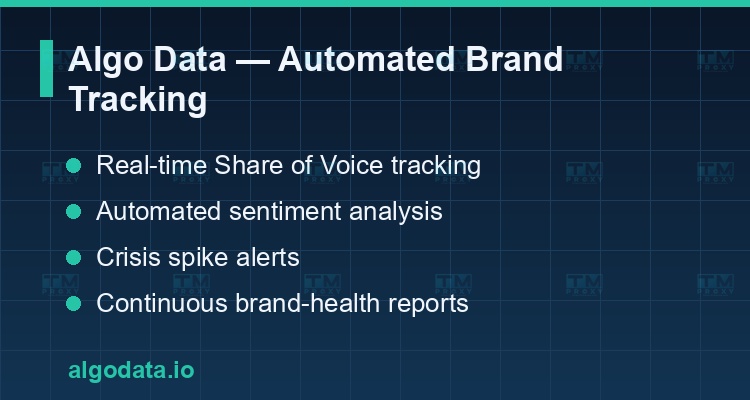
Most brand-health metrics live inside conversations on Facebook, TikTok, YouTube, forums and e-commerce platforms. Algo Data is a social-data analytics platform that automates this measurement:
- Share of Voice tracking — compare your discussion share with competitors in real time
- Automated sentiment analysis — classify positive/negative/neutral tone across thousands of mentions
- Crisis alerts — detect negative spikes the moment they appear
- Periodic brand-health reports — a continuously updated dashboard instead of manual surveys
A step-by-step process to build a brand measurement system
- Define the goal — do you want more awareness, better sentiment, or higher loyalty? The goal decides the metrics.
- Pick 3–5 core metrics — do not measure everything; start with SoV, Sentiment, Brand Mentions.
- Set a baseline — measure the current state as a reference point.
- Collect data continuously — use social listening for a real-time data stream.
- Track in rhythm — a daily dashboard for alerts, monthly reports for trends.
- Act & iterate — measure the before/after delta of each campaign to see real impact.
Conclusion: Brand measurement is not a cost — it is a positioning system that tells you where you are and whether you are heading the right way. Start small with three social-media metrics, measure continuously rather than once a year, and let data — not intuition — guide your brand decisions.