





Your customers are talking about your brand every single day — but most of that conversation happens where you are not present. Social listening is how you hear the entire market, not just your own page.
What is social listening?
High-Speed Proxy - Ready to Try?
ALGO Proxy offers residential, datacenter & 4G proxies in 195+ countries
Social listening is the process of tracking, collecting and analyzing what people say about a brand, product, competitor or topic across social media, forums, news and e-commerce platforms — in order to extract insights that drive business decisions.
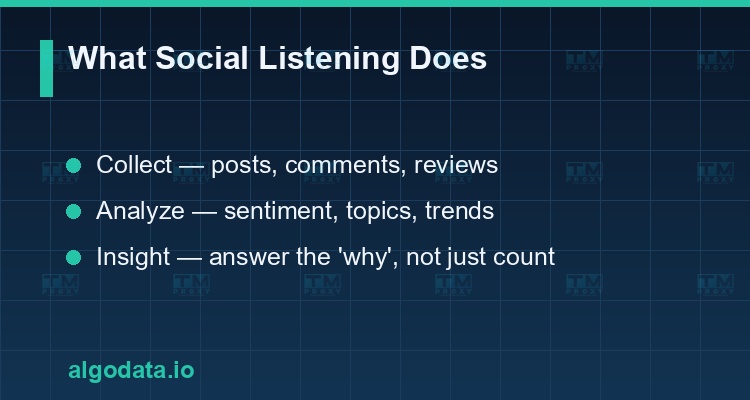
The key point: social listening does not stop at counting mentions. It answers the question "why": why customers love or dislike you, which trends are rising, how competitors are being talked about. That is the difference between hearing noise and understanding the story.
How is social listening different from marketing and monitoring?
This is where many people get confused. Three completely different concepts:
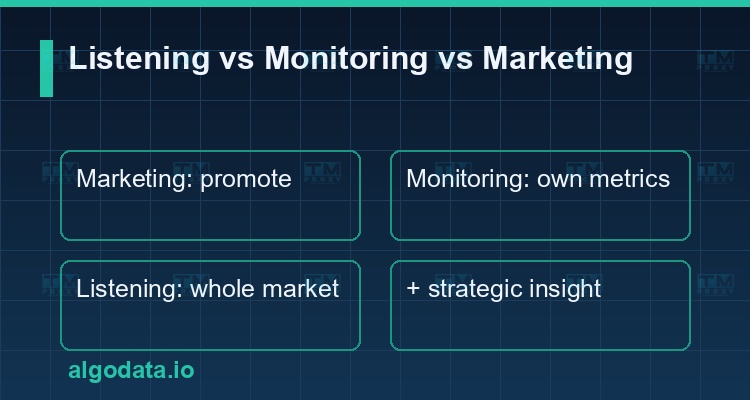
- Social media marketing — an activity: posting, running ads, building channels to promote your brand.
- Social media monitoring — surface measurement: tracking likes, followers and engagement on your own channels.
- Social listening — strategic listening & analysis: tracking the whole market (including where you have no presence), understanding sentiment, share of voice and trends to inform decisions.
In short: marketing is talking, monitoring is counting your own views, and social listening is hearing the whole market and extracting insight.
What is a social listening tool and what does it do?
What does social listening actually do? At its core, four things: listen (collect conversations), understand (analyze sentiment and topics), compare (measure share of voice against competitors) and alert (warn when something abnormal happens). To do those four things across thousands of mentions a day, a business cannot work manually — it needs a tool.
A social listening tool is software that automates the entire listening workflow. A typical tool will:
- Collect from multiple sources — Facebook, TikTok, YouTube, forums, news, e-commerce reviews.
- Analyze sentiment — classify each mention as positive, negative or neutral.
- Measure Share of Voice — your share of discussion versus competitors.
- Detect trends & topics — which themes are rising, which keywords attach to your brand.
- Alert on crises — warn when negative volume spikes abnormally.
In Vietnam, popular tools include Algo Data, Buzzmetrics and YouNet Media. The decisive quality factor is the ability to understand the local language — slang, abbreviations, diacritics and sarcasm.
Why does a business need social listening?
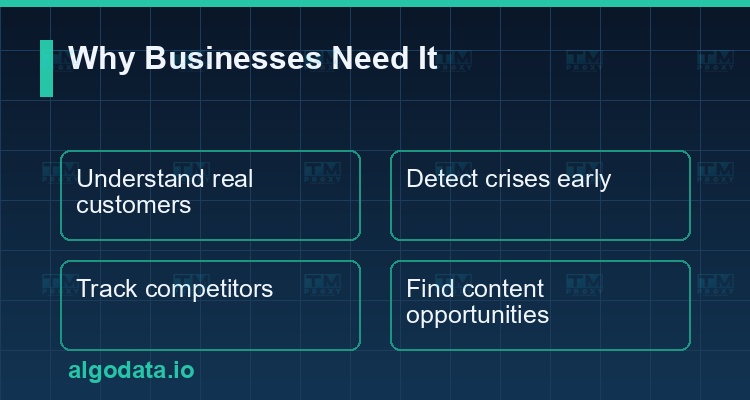
- Understand real customers — hear their actual language and pain points instead of guessing.
- Detect crises early — handle a negative wave within hours, before it reaches the press.
- Track competitors — know what rivals are praised or criticized for, and find the gap.
- Measure campaign impact — compare share of voice and sentiment before and after a campaign.
- Find content & product opportunities — spot unmet needs directly from customer conversations.
A real-world example: an F&B brand discovered through social listening that customers complained about delivery time far more than about food quality — an insight almost invisible in sales reports alone. They focused on fixing delivery, and positive sentiment rose noticeably the following month. That is the power of listening in the right place instead of guessing.
How does social listening work?
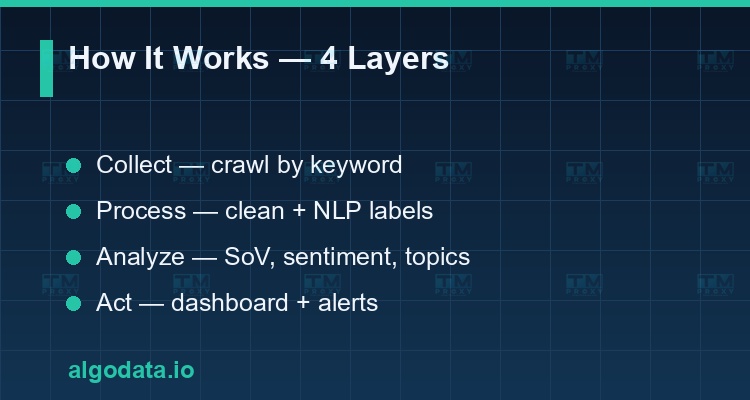
The social listening process has four layers:
- Collect — crawl posts, comments and reviews by target keyword, continuously and in real time.
- Process — clean the data, normalize local-language text, then have an NLP model label sentiment and classify topics.
- Analyze — aggregate into metrics: buzz volume, sentiment, share of voice, top topics/influencers.
- Act — a dashboard plus alerts help marketing/PR teams make timely decisions.
Local-language social listening: why a native model matters
Social listening on a local language such as Vietnamese is much harder than on English. Social-media text is full of traps for machines:
- Slang & abbreviations that change constantly within young communities.
- Dropped diacritics that alter or obscure meaning.
- Sarcasm — apparent praise that actually means criticism, depending on context.
- Meaning-flipping emojis — a compliment followed by an eye-roll emoji means the opposite.
- Code-switching — mixing English words into local-language sentences.
A model trained on English will misclassify most of these cases, producing wrong sentiment metrics and wrong decisions. That is why, for a market like Vietnam, the single most important factor when choosing a social listening tool is whether its NLP model is trained on real local social-media data — not a thin localization layer bolted onto a foreign tool.
How to implement social listening and choose a tool
Basic implementation steps:
- Define your goal — tracking brand health, competitors, or measuring a campaign?
- Build a keyword list — brand name (including misspellings/abbreviations), products, competitors, hashtags.
- Choose a tool — prioritize one that understands your local language and covers the platforms that matter (Facebook, TikTok, Shopee).
- Set up dashboard & alerts — monitor daily and set negative-spike thresholds.
- Turn insight into action — review periodically and adjust content/product strategy.
Criteria for choosing a social listening tool: source coverage, local-language sentiment accuracy, alert speed, and competitor-analysis capability.
Algo Data — a social listening platform for the local market
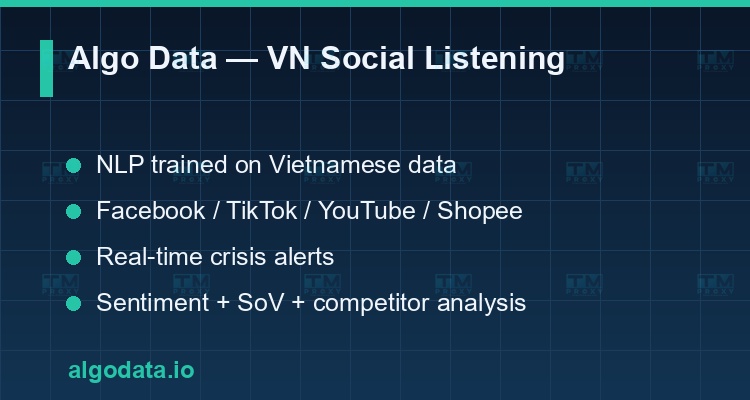
Algo Data is a social-data analytics platform built for the Vietnamese market:
| Need | How Algo Data delivers |
|---|---|
| Understand the local language | NLP trained on Vietnamese social data — handling slang, emojis, sarcasm |
| Full platform coverage | Continuous collection from Facebook, TikTok, YouTube, Shopee |
| Timely alerts | Real-time detection of negative spikes |
| Strategic insight | Sentiment dashboard + share of voice + topic trends + competitor analysis |
Collecting data at scale for social listening requires stable proxy infrastructure to avoid IP blocking — which is why Algo Data runs on a strong data-collection backbone.
Conclusion: Social listening is not about "counting likes" — it is how a business hears the entire market and turns thousands of conversations into actionable insight. Start with a few important keywords, choose a tool that understands your language and covers the right platforms, then let the true voice of your customers guide your decisions.