





Every day, customers talk about your brand thousands of times — on Facebook, TikTok, Shopee reviews and community groups. Are you actually listening, or just guessing? Customer sentiment analysis turns that messy stream of comments into numbers you can act on.
What is customer sentiment analysis?
High-Speed Proxy - Ready to Try?
ALGO Proxy offers residential, datacenter & 4G proxies in 195+ countries
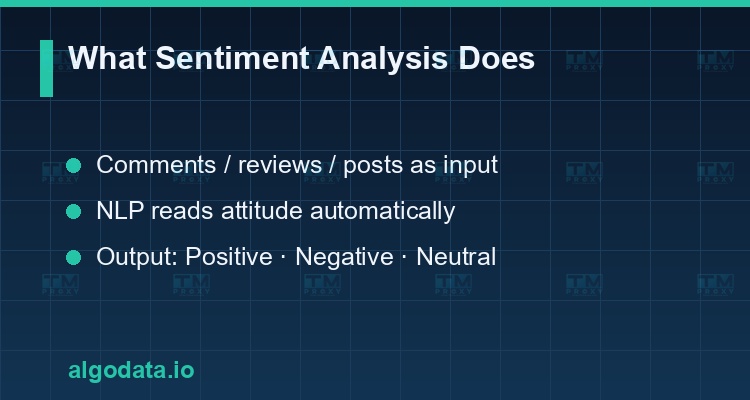
Customer sentiment analysis is the use of natural language processing (NLP) to automatically read and classify the attitude inside everything customers write: comments, product reviews, social posts and support messages.
Instead of one employee manually reading 5,000 comments — slow and subjective — a sentiment system tags each line as positive, negative or neutral, then aggregates it into a metric. One glance at a dashboard tells you whether your brand is loved or criticized this week, and whether the campaign you just launched created goodwill or backfired.
It is the difference between feeling that "people seem happy" and knowing that positive sentiment rose from 62% to 78% after a product update.
What is the purpose of customer sentiment analysis?
This is the most important question — because without a clear purpose, sentiment data is just a pretty number. The practical purposes:
- Measure satisfaction in real time — no waiting for a quarterly survey; know immediately whether customers are happy or upset.
- Detect crises early — a negative spike is flagged within hours instead of days.
- Evaluate campaign effectiveness — measure sentiment before and after a campaign to see whether it built goodwill or sparked controversy.
- Surface product/service issues — when the same complaint repeats (slow delivery, a broken feature), negative sentiment grouped by topic points straight to the problem.
- Benchmark against competitors — know whether your brand is liked more or less than rivals in the same period.
What is sentiment analysis vs emotion analysis?
Two concepts that are easily confused:
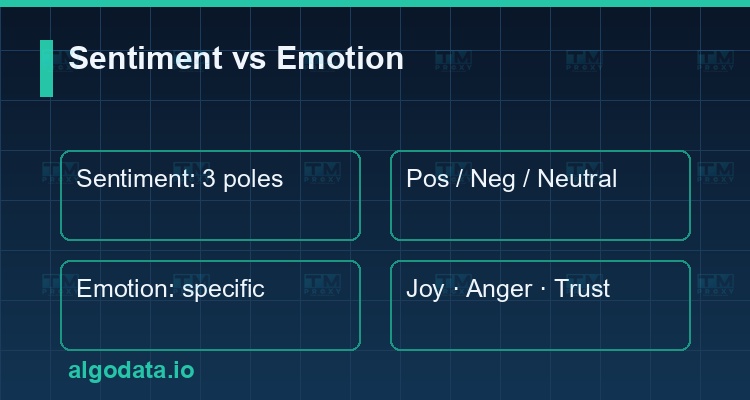
- Sentiment analysis: classifies by polarity — positive / negative / neutral. This is the common implementation level and is enough for most businesses.
- Emotion analysis: more detailed, recognizing specific emotions like joy, anger, disappointment, trust or surprise.
In practice the two terms are used interchangeably. A good system should start with three-pole sentiment (easy to measure, easy to act on) and expand into emotion when depth is needed.
What is customer analysis and where does sentiment fit?
People often confuse "customer analysis" with "customer sentiment analysis." Customer analysis is the broad discipline — it covers demographics (age, gender, region), purchase behavior, customer lifecycle, lifetime value (CLV) and attitude/emotion. Sentiment analysis is therefore a specialized branch of customer analysis: it answers "how do customers feel," while the other branches answer "who customers are" and "what customers do."
Why does the emotional dimension deserve its own focus? Because it is a leading indicator: customers start expressing frustration on social media long before revenue numbers dip. A business that catches the emotional signal early has time to react; a business that only reads sales reports always reacts late.
What is customer emotion — classification on social media
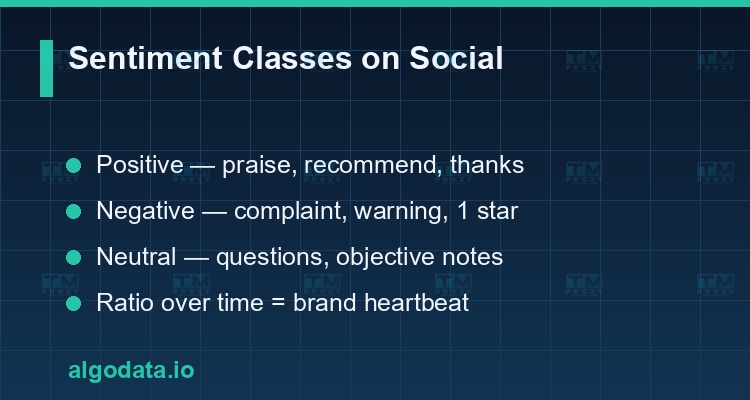
Customer emotion is the affective reaction to a brand or product, revealed through words, emojis and tone. On social media, sentiment is usually grouped as:
- Positive — praise, recommendation, gratitude ("great support", "works perfectly", ❤️😍).
- Negative — criticism, complaint, warning others ("scam", "wrong item", "1 star", 😠).
- Neutral — asking for information, comparing, objective remarks with no strong emotion.
The ratio of these three groups over time is the emotional "heartbeat" of your brand.
The challenge of Vietnamese sentiment analysis
Beyond language, there is a data challenge: sentiment is scattered across many platforms, and unless it is collected fully and continuously, the picture will be skewed.
Practical use cases: brand monitoring, campaigns, crises
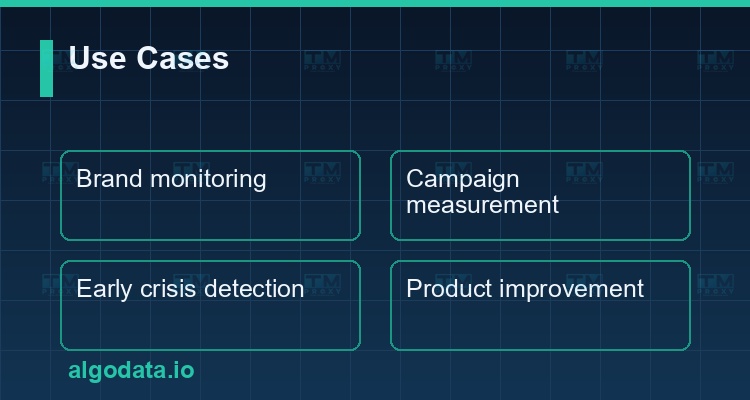
- Brand monitoring — track brand sentiment daily and set alert thresholds when negativity rises abnormally.
- Campaign measurement — compare sentiment before / during / after a campaign to see real impact, not just reach.
- Early crisis detection — spot a negative wave the moment it begins and act before it reaches the press.
- Product improvement — group negative feedback by topic to know what to fix first.
How to collect sentiment data from social media
Analysis is only as good as its input data. Sentiment sources in a market like Vietnam:
- Facebook — comments, posts, community groups.
- TikTok — video comments, product reviews, livestreams.
- Shopee / e-commerce — product reviews and comments (extremely rich in real sentiment).
A typical collect-and-analyze pipeline has four steps:
- Define sources & keywords — brand name, products, competitor names, campaign hashtags.
- Collect continuously — crawl comments/posts/reviews in real time, through proxies to avoid IP blocking.
- Clean & label — remove spam/duplicates, normalize Vietnamese text (restore diacritics, separate emojis), then have the NLP model assign sentiment labels.
- Aggregate & alert — push to a dashboard by topic/platform and set thresholds that alert when negativity spikes.
Collecting data at scale and continuously requires stable residential proxy infrastructure to avoid IP blocking while crawling. This is why any serious sentiment-analysis system is paired with a strong data-collection backbone — incomplete data skews the sentiment metric and leads to wrong decisions.
Proxies for crawling social data to power sentiment analysis
How Algo Data solves Vietnamese sentiment analysis
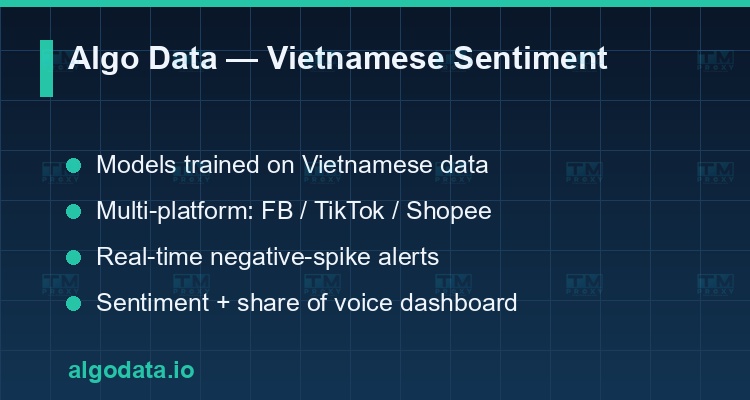
Algo Data is a social-data analytics platform built for the Vietnamese market:
| Need | How Algo Data delivers |
|---|---|
| Understand Vietnamese correctly | NLP models trained on Vietnamese social data — handling slang, emojis, sarcasm |
| Complete data | Multi-platform collection (Facebook, TikTok, Shopee), continuously |
| Timely alerts | Detect negative sentiment spikes in real time |
| Decision-ready output | Sentiment dashboard + share of voice + topic trends |
Instead of reading manually or using foreign tools that misread Vietnamese, Algo Data gives you an accurate emotional picture to act on.
Conclusion: Customer sentiment analysis is not a luxury technology — it is how you hear the true voice of your customers at scale. Start with three-pole sentiment on your most important channels, make sure the input data is complete and the model truly understands Vietnamese, then let customer emotion guide your brand decisions.