





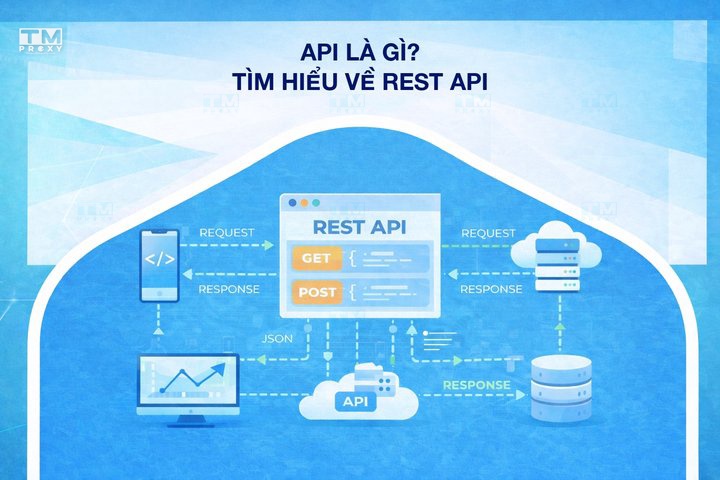
API (Application Programming Interface) is a set of rules that allows software applications to communicate with each other. This article explains in detail what an API is, how REST APIs work, authentication methods, good API design principles, and real-world applications in everyday life.
What is an API?
API (Application Programming Interface) is a set of rules, protocols, and tools that allows software applications to communicate with each other. Simply put, an API is the "middleman" that helps two pieces of software understand and interact with each other without needing to know the other's internal details.
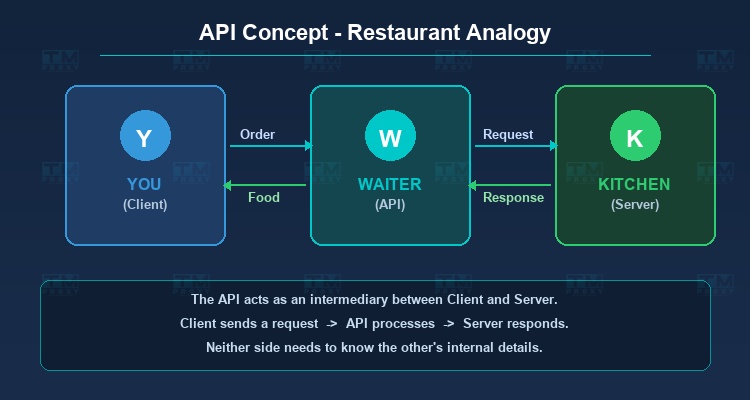
A Simple Real-World Analogy
Imagine you're sitting in a restaurant:
- You are the client application (the user).
- The kitchen is the server (where requests are processed).
- The waiter is the API — takes your order, delivers it to the kitchen, then brings the completed dish back to you.
You don't need to know how the kitchen cooks, and the kitchen doesn't need to know where you're sitting. The API ensures smooth communication between both sides.
High-Speed Proxy - Ready to Try?
ALGO Proxy offers residential, datacenter & 4G proxies in 195+ countries
Common Types of APIs
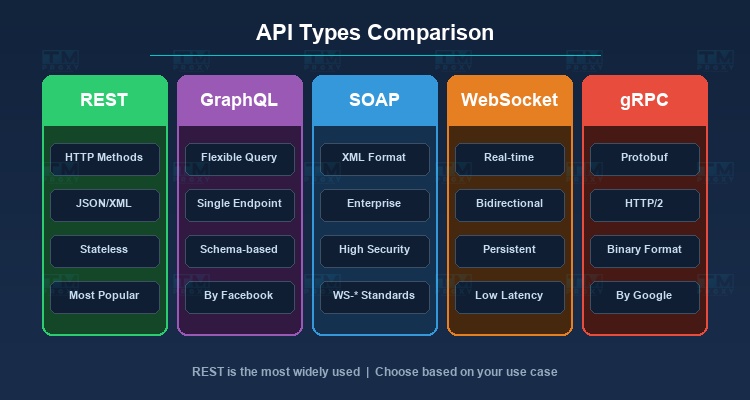
REST API (RESTful API)
REST (Representational State Transfer) is the most popular API architecture today. REST APIs use the HTTP protocol with standard methods:
- GET: Retrieve data (e.g., fetch a product list).
- POST: Create new data (e.g., place an order).
- PUT: Update entire data (e.g., update customer information).
- PATCH: Partially update data.
- DELETE: Remove data.
Key characteristics of REST API:
- Uses URLs (endpoints) to identify resources.
- Responses are typically in JSON or XML format.
- Stateless — each request is independent, not dependent on previous requests.
- Easy to understand, implement, and widely supported.
GraphQL
Developed by Facebook, GraphQL allows clients to specify exactly what data they need in a single request, avoiding over-fetching or under-fetching.
Advantages:
- Flexible data querying.
- Reduces the number of required requests.
- Clear schema that auto-generates documentation.
Disadvantages:
- More complex than REST to implement.
- Harder to cache effectively.
SOAP API
SOAP (Simple Object Access Protocol) is an older protocol that uses XML for data exchange. Still used in enterprise, banking, and government systems thanks to its high security and reliability.
WebSocket API
WebSocket enables real-time bidirectional communication between client and server. Ideal for chat, online gaming, stock price tracking, and real-time notifications.
gRPC
Developed by Google, gRPC uses Protocol Buffers (protobuf) for data serialization. Faster than REST thanks to HTTP/2 and binary format, making it ideal for microservices.
How Does a REST API Work?
Structure of an API Request
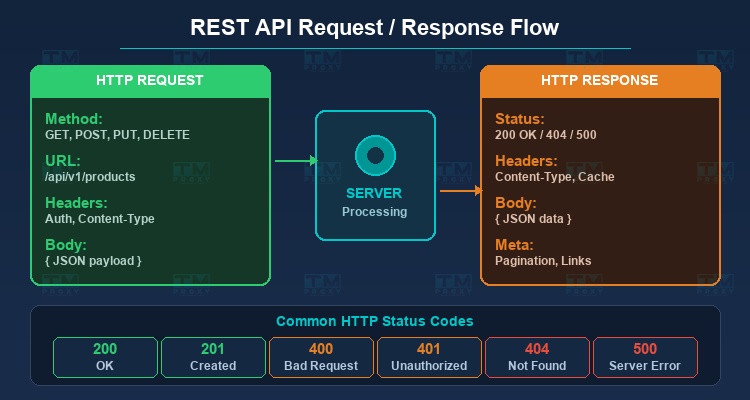
A REST API request consists of these components:
Endpoint (URL): The address identifying the resource to access:
GET https://api.example.com/v1/products
GET https://api.example.com/v1/products/123
HTTP Method: The method specifying the action to perform (GET, POST, PUT, DELETE).
Headers: Additional information like authentication tokens, content type, language:
Authorization: Bearer eyJhbGciOiJIUzI1NiJ9...
Content-Type: application/json
Accept-Language: en
Body (Request Payload): Data sent along (typically used with POST and PUT):
{
  "name": "New Product",
  "price": 12.99,
  "category": "electronics"
}
Query Parameters: Filters and options appended to the URL:
GET /products?category=electronics&sort=price&page=1
Structure of an API Response
The server responds with:
HTTP Status Code:
200 OK— Success.201 Created— Successfully created.400 Bad Request— Invalid request.401 Unauthorized— Not authenticated.403 Forbidden— Access denied.404 Not Found— Resource doesn't exist.429 Too Many Requests— Rate limit exceeded.500 Internal Server Error— Server error.
Response Body: Returned data, typically in JSON format:
{
  "status": "success",
  "data": {
    "id": 123,
    "name": "New Product",
    "price": 12.99
  }
}
API Authentication
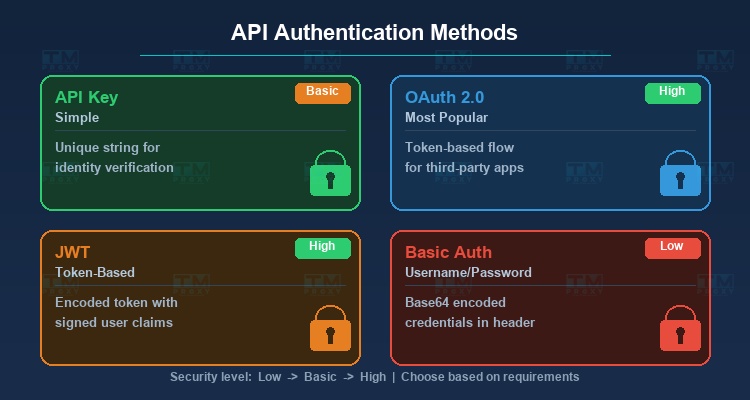
To protect APIs from unauthorized access, several authentication methods exist:
API Key
The simplest method — the server issues the client a unique string (API Key) to verify identity. API Keys are typically sent via headers or query parameters.
OAuth 2.0
The most popular authentication protocol for web and mobile applications. Allows you to log into apps using your Google or Facebook account without sharing your password.
JWT (JSON Web Token)
An encoded token containing user information, signed with a secret key. The server can verify the token without querying the database.
Basic Authentication
Sends username and password via HTTP header, encoded in Base64. Simple but less secure without HTTPS.
Good API Design — Fundamental Principles
Clear Endpoint Naming
Use plural nouns that describe resources:
✅ /api/v1/products
✅ /api/v1/users/123/orders
❌ /api/v1/getProducts
❌ /api/v1/create-new-order
Use Versioning
Version your API to avoid breaking changes during updates:
/api/v1/products
/api/v2/products
Pagination
Don't return all data in a single response. Use pagination to reduce load:
/products?page=1&limit=20
Rate Limiting
Limit requests per client within a timeframe to protect the server:
X-RateLimit-Limit: 1000
X-RateLimit-Remaining: 999
X-RateLimit-Reset: 1640000000
Consistent Error Handling
Return clear and consistent error messages:
{
  "error": {
    "code": "VALIDATION_ERROR",
    "message": "The 'email' field is invalid",
    "details": [
      {"field": "email", "message": "Must be a valid email"}
    ]
  }
}
APIs and Proxies — A Practical Connection
In many scenarios, APIs and proxies work closely together:
API Scraping with Proxies
Many services offer public APIs but enforce strict rate limits. Using proxies helps distribute requests across multiple IPs, avoiding blocks when making high-frequency API calls.
API Gateway and Reverse Proxy
An API Gateway acts as a reverse proxy for microservices, handling authentication, rate limiting, load balancing, and routing for all API requests.
Proxy APIs
Proxy providers like TMProxy offer APIs to manage proxies programmatically — creating, deleting, rotating IPs, and monitoring usage through API calls.
API Development and Testing Tools
-
Postman: The most popular API testing tool, supporting collections, environments, and automated testing.
-
Insomnia: Similar to Postman with a lighter interface. Supports REST, GraphQL, and gRPC.
-
Swagger/OpenAPI: An API description standard that enables automatic and interactive documentation generation.
-
curl: A simple but powerful command-line tool for sending HTTP requests.
| Metric | REST API | GraphQL | gRPC |
|---|---|---|---|
| Avg Latency | 45ms | 52ms | 12ms |
| Throughput | 2200 req/s | 1800 req/s | 5500 req/s |
| Payload size | 8.2 KB | 3.1 KB | 1.8 KB |
| Ease of implementation | High | Medium | Low |
gRPC is fastest thanks to HTTP/2 and binary format, but harder to implement. REST is simplest and suitable for most use cases. GraphQL optimizes payload but has higher latency due to query parsing.
APIs in Everyday Life
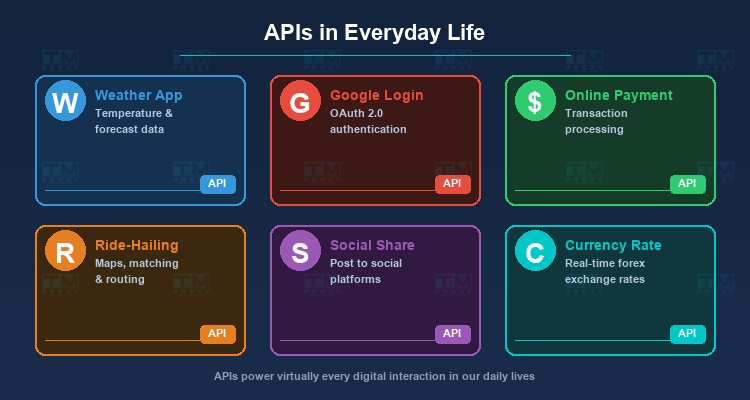
You might not realize it, but APIs are present in nearly every digital activity you perform daily:
Weather Apps
When you open a weather app on your phone, the app calls an API from a meteorological service (like OpenWeatherMap or WeatherAPI) to fetch temperature, humidity, and forecast data based on your current GPS coordinates. Every refresh is an API call.
Google/Facebook Login (OAuth)
When you click "Sign in with Google" on a website, the application uses Google's OAuth 2.0 API to authenticate your identity without requiring you to create a new account or share your password. This process involves multiple API calls between the application, Google Authorization Server, and Google Resource Server.
Online Payments
When you make a payment on an e-commerce site, the website calls a payment gateway's API (Stripe, PayPal, Square) to process the transaction. The API verifies the card, checks the balance, executes the transaction, and returns the result — all within seconds.
Ride-Hailing Apps
Uber, Lyft, and other ride-hailing apps use dozens of APIs simultaneously: Google Maps API for maps and routing, internal APIs for driver matching, Payment APIs for transactions, and Push Notification APIs for real-time alerts.
Social Media Sharing
The "Share on Facebook" button on websites uses the Facebook Graph API to post content to your timeline. Twitter/X API, LinkedIn API work similarly — allowing third-party applications to interact with the platform without direct access.
Currency Exchange
Banking and finance apps use Exchange Rate APIs to fetch real-time forex rates. Every time you check the USD/EUR rate, the app is calling an API from a financial data provider.
REST API Best Practices for Production
When deploying APIs in production environments, follow these best practices to ensure performance, security, and scalability:
Enforce HTTPS
All production APIs must use HTTPS. Unencrypted HTTP exposes data — including API keys, tokens, and sensitive information — to anyone on the network. Use TLS 1.3 for optimal security and redirect all HTTP requests to HTTPS.
Implement Caching with ETags and Cache-Control
Use HTTP caching headers to reduce server load and speed up responses. ETags allow clients to check whether data has changed before reloading. Cache-Control headers specify cache duration for each response type, significantly reducing the number of requests hitting the origin server.
Enable Compression
Enable gzip or Brotli compression for API responses. For JSON data, compression can reduce payload size by 60-80%, dramatically improving response times especially on slow connections. Most modern frameworks support automatic compression.
Configure CORS Properly
Cross-Origin Resource Sharing (CORS) controls which domains can call your API. Configure CORS strictly — only allow trusted domains, specify accepted methods and headers. Avoid using wildcard * in production as it allows any domain to call your API.
Document with OpenAPI/Swagger
An API without documentation is a useless API. Use OpenAPI Specification (OAS) to describe your API in a standardized format. Swagger UI automatically generates interactive documentation from OAS, allowing developers to test the API directly. Always keep documentation updated when the API changes.
Use Meaningful HTTP Status Codes
Use correct HTTP status codes: 200 for success, 201 for created, 204 for no content, 400 for client errors, 401 for unauthorized, 403 for forbidden, 404 for not found, 429 for rate limiting, 500 for server errors. Don't return 200 for every response with errors in the body — this makes error handling difficult for clients.
Notable API Trends
API-First Design
An increasing number of organizations adopt the "API-first" approach — designing APIs before writing code. APIs are treated as products, with careful design, comprehensive documentation, and clear versioning from the start. This ensures consistency across teams and reduces rework.
GraphQL Continues to Grow
GraphQL is gaining wider adoption, especially for mobile apps and dashboards that need complex data queries. However, REST still dominates for most use cases thanks to its simplicity and rich tooling. Many organizations use a combination of both REST and GraphQL.
API Marketplaces
API marketplace platforms like RapidAPI allow developers to discover, connect, and manage thousands of APIs from a single place. The "API as a Product" model is becoming increasingly popular, with companies monetizing data and services through APIs.
Serverless and Edge APIs
APIs are being deployed on serverless platforms (AWS Lambda, Cloudflare Workers, Vercel Edge Functions) to reduce costs, increase scalability, and reduce latency. Edge computing brings API logic closer to users, significantly improving response times for global audiences.
AI and Machine Learning APIs
AI/ML APIs are booming — from OpenAI's GPT API and Google Cloud AI to specialized services for image recognition, natural language processing, and automatic translation. AI APIs enable developers to integrate AI capabilities into applications without building models from scratch.
Conclusion: APIs are the connective foundation of the modern software world. Understanding APIs — especially REST APIs — is an essential skill for anyone working in technology. Whether you're a developer building applications, a marketer integrating tools, or a business looking to connect systems, APIs are the bridge that makes everything work together.